By Madeleine Panahandeh, Staff Writer
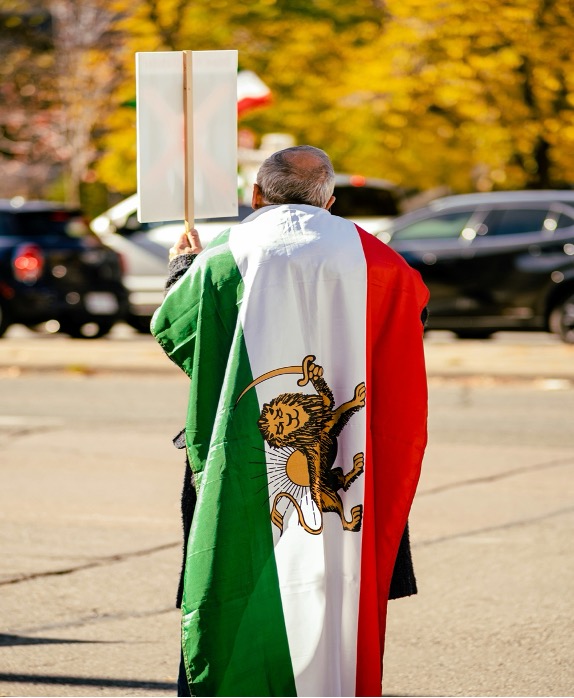
As many were celebrating Valentine’s Day this year, hundreds of thousands of others poured into the streets of cities across the globe, including Munich, Los Angeles, Toronto, and Tel Aviv, to protest the current regime in Iran.[1] Many held signs that either opposed Khamenei, the current Supreme Leader of Iran, or called for the exiled Crown Prince, Reza Pahlavi, to return to Iran and establish a secular democratic state.[2] Since 1979, Iran has been ruled by the Islamic Republic which has created great political turmoil and isolated the country and its citizens from the Western world.[3] For decades, the Iranian people have been demanding a change in their leadership by protesting in Iran’s major cities, despite threats of imprisonment or potential violence inflicted by the Islamic Revolutionary Guard (IRGC).[4] Most recently, protests erupted last December in response to Iran’s deepening economic crisis and significant rise in inflation.[5] An independent Iranian human-rights news outlet has reported that approximately 7,000 protestors have been killed by the IRGC as a result of such protests. [6]
It is a critical situation that has resulted in foreign military intervention. However, the issue presented here is how international law and intergovernmental organizations (IGOs), such as the United Nations (UN), can assist the people of Iran in securing their fundamental human rights. The United Nations has been instrumental in establishing the standards of international law through treaties such as the Convention against Torture and Other Cruel, Inhuman or Degrading Treatment or Punishment, and the Convention on the Elimination of All Forms of Discrimination Against Women.[7]While treaties are not legally binding unless ratified by the State, the UN may still take action through the principles set forth in the Charter of the United Nations.[8] The UN Charter grants the General Assembly authority to initiate studies and provides recommendations to promote the development and universal implementation of international law.[9]Through these mandates, the UN can collect evidence of violations of international human rights law that can later be used in international tribunals.[10]
In the case of Iran, the United Nations first established an independent international fact-finding mission on the Islamic Republic in 2022.[11] This mission was created in response to the death of Mahsa Amini, a young Persian woman who died while in the custody of the Islamic Republic’s morality police for improperly wearing her hijab.[12] Her death sparked mass protests across the country, which were met with a forceful response by the IRGC.[13] The original mandate condemned the government’s response to the protests and urged the Islamic Republic to ensure the protection of all peaceful demonstrators.[14] The mission also called for a thorough and independent investigation into the alleged human rights abuses taking place during the protests, with a specific focus on violations against women and children.[15]
Although the initial mandate was intended to last for one year, it has been extended several times due to ongoing political unrest in Iran.[16] The most recent extension, in December of 2025, was enacted in response to the economic crisis and the nationwide protests previously described above.[17] Despite continuous governmental efforts to manage demonstrations, the political protests are likely to continue for the foreseeable future. With no perceived end in sight, the question presented is in what capacity international law can and will be used to ensure a safe and free Iran for all of its people.
[1] https://www.theguardian.com/world/2026/feb/15/rallies-held-across-the-world-in-support-of-irans-anti-government-protesters
[3] https://www.cbsnews.com/news/iran-protest-arrests-government-crackdown-reza-pahlavi/
[4] https://www.amnesty.org/en/latest/campaigns/2026/01/what-happened-at-the-protests-in-iran/
[6] https://www.pbs.org/newshour/world/more-than-7000-dead-in-irans-crackdown-on-protests-activists-say
[7] https://tbinternet.ohchr.org/_layouts/15/TreatyBodyExternal/Treaty.aspx?CountryID=81&Lang=EN
[8] https://www.un.org/en/our-work/uphold-international-law#:~:text=The%20UN%20Charter%20gives%20the,and%20report%20to%20the%20plenary.
[9] https://www.un.org/en/our-work/uphold-international-law#:~:text=The%20UN%20Charter%20gives%20the,and%20report%20to%20the%20plenary.
[10] https://lordslibrary.parliament.uk/un-commissions-of-inquiry-and-fact-finding-missions/#heading-2
[11] https://www.ohchr.org/en/hr-bodies/hrc/ffm-iran/index
[12] https://www.amnesty.org/en/latest/news/2024/09/iran-two-years-after-woman-life-freedom-uprising-impunity-for-crimes-reigns-supreme/#:~:text=People%20in%20Iran%20continue%20to,%E2%80%9CWoman%20Life%20Freedom%E2%80%9D%20uprising%20amid
[14] https://docs.un.org/en/A/HRC/RES/S-35/1
[15] https://www.hrw.org/news/2024/03/21/un-rights-council-renew-iran-mandates
[16] https://www.ohchr.org/en/media-advisories/2026/01/human-rights-council-adopts-resolution-extending-mandates-fact-finding