By: Lauren Shovlin, Staff Writer
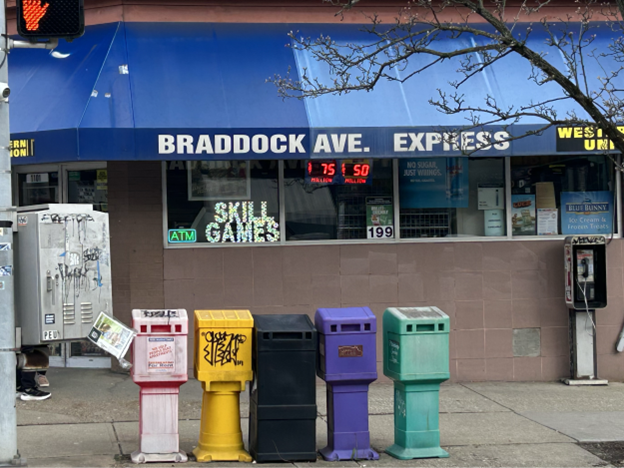
Photo courtesy of Lauren Shovlin
Skill games are machines that resemble casino slot machines but profess to rely on a player’s ability to memorize and recognize patterns to achieve success.[1] These devices look and function like slots: money is inserted into the machine, converted into points, and used to play tic-tac-toe and similar puzzles. One key distinction, however, is after a hit or loss, players have an option to recoup lost points through a “Follow Me” feature.[2] During this optional second phase, players must repeat a pattern of multiple, multi-colored dots—a memorization game the skill games industry argues is predominantly based on skill.[3] The dispute over whether these games constitute gambling turns on this second phase, which supporters contend is based on skill, but critics argue is not meaningfully skill-based and is completely optional.
Currently, Pennsylvania courts hold that skill games are predominantly games of skill and are therefore not illegal gambling devices subject to the Crimes Code.[4] In two 2023 decisions, the Commonwealth Court held that (1) skill games were not covered by the Crimes Code, placing them outside the regulatory oversight of the Pennsylvania Gaming Control Board (PGCB), and (2) that under the “predominant factor” test, skill predominates over chance, excluding the devices from its per se gambling classification.[5] As a consequence of their unclear legal status, these devices remain unregulated, untaxed, and largely unchecked in their rapid expansion into virtually every public establishment, from gas stations and convenience stores, to bars, restaurants, fraternal and veterans’ clubs.[6] Nationally, there are at least roughly 625,000 skill games in operation,[7] which translates into 40% of all gaming machines in America as unlicensed.[8]
The proliferation of skill games is of particular import to Pennsylvania, which hosts more of these machines than any other state in the nation, with estimates as high as 100,000.[9] This concentration places Pennsylvania at the center of the ongoing regulatory and legal debate surrounding these machines.
While Pennsylvania skill games present a multitude of issues,[10] consumer protection is a concern that is often lost amid revenue and tax debates. By embedding themselves into everyday establishments, skill games transform gambling from an intentional choice to an incidental part of daily life.[11] Unlike casinos, which require a player to travel to site, pass security, and play under the vigilance of surveillance officers and security guards, skill games are virtually unavoidable and unsupervised in local establishments.[12]
The damaging consequences of their widespread presence in local communities is not confined to Pennsylvania. In Missouri, Ron Foreman,[13] who had managed his gambling addiction since 2004 through Missouri’s List of Disassociated Persons,[14] relapsed after unregulated skill games began popping up in his local grocery store “tucked between the eggs and milk to the gas station down the street.”[15] Despite his efforts to overcome addiction, Foreman’s inability to avoid locations offering risk-based play ultimately led to his gambling away hundreds of thousands of dollars, leading to financial ruin.[16] Unregulated access to skill games not only promotes and perpetuates addictions among adults, but also exposes minors to gambling.[17] Unlike casinos, which face substantial fines for admitting minors, there are rarely systems in place to enforce age restrictions at skill games establishments.[18] Unregulated skill games pose significant risks not only to players but to communities at large, contributing to the emergence of “mini casinos” in local establishments, and increasing dependence by small businesses on gambling revenue from unsuspecting customers.[19] Ultimately, the pervasive access to skill games should necessitate more—not less—regulation to ensure consumer safety.
[1] Frank Ammirante, Pennsylvania Supreme Court to Decide Fate of Skill Games, Deadspin (Apr. 20, 2026), https://deadspin.com/legal-betting/pennsylvania-supreme-court-to-decide-fate-of-skill-games/.
[2] In re Three Pennsylvania Skill Amuse. Devices, 306 A.3d 432, 436 (Pa. Cmmw. 2023).
[3] See Pinnacle Amusement, LLC v. Bureau of Liquor Control Enf’t, 298 A.3d 447 (2023).
[4] https://penncapital-star.com/criminal-justice/does-an-element-of-skill-make-a-slot-machine-something-other-than-a-gambling-device/
[5] See Pinnacle Amusement, LLC v. Bureau of Liquor Control Enf’t, 298 A.3d 447 (2023); In re Three Pa. Skill Amusement Devices, 306 A.3d 432 (2023).
[6] https://www.pennlive.com/opinion/2025/12/testimony-makes-clear-skill-games-put-pennsylvanians-at-risk-opinion.html
[7] American Gaming Association, Illegal Gambling, (2026) https://www.americangaming.org/illegalgambling/.
[8] Id.
[9] Evan W. Davis, Better to be lucky than good? The Supreme Court of Pennsylvania will take up question of what constitutes ‘skill’ gaming, CasinoReports.com, (Jul. 17, 2024), https://www.rccblaw.com/publication-skill-gaming.
[10] These issues include regulatory oversight, taxation levels, limits on number and location, and enforcement mechanisms.
[11] https://www.pennlive.com/opinion/2025/12/testimony-makes-clear-skill-games-put-pennsylvanians-at-risk-opinion.html
[12] https://www.blankrome.com/publications/multimillion-dollar-jury-verdict-highlights-lack-skill-game-regulation-eve
[13] https://arnoltcenter.org/work/gaming-the-system-skill-games-create-regulatory-confusion-across-the-nation/
[14] This is a directory created by the state’s gaming commission that excludes problem gamblers from visiting any licensed casinos in the state.
[15] https://arnoltcenter.org/work/gaming-the-system-skill-games-create-regulatory-confusion-across-the-nation/
[16] Id.
[17] https://www.phillytrib.com/commentary/skill-games-a-menace-to-community-well-being/article_60968a01-c2e9-56ee-8d49-6bc49e848d9e.html
[18] Some machines state age requirements to play or that an ID is required to claim any winnings, but many machines have neither. See https://www.americangaming.org/illegalgambling/.
[19] https://www.cityandstatepa.com/policy/2024/08/battle-over-how-legislate-skill-games-everyone-playing-keeps/399021/