By: Lauren Shovlin, Juris Writer
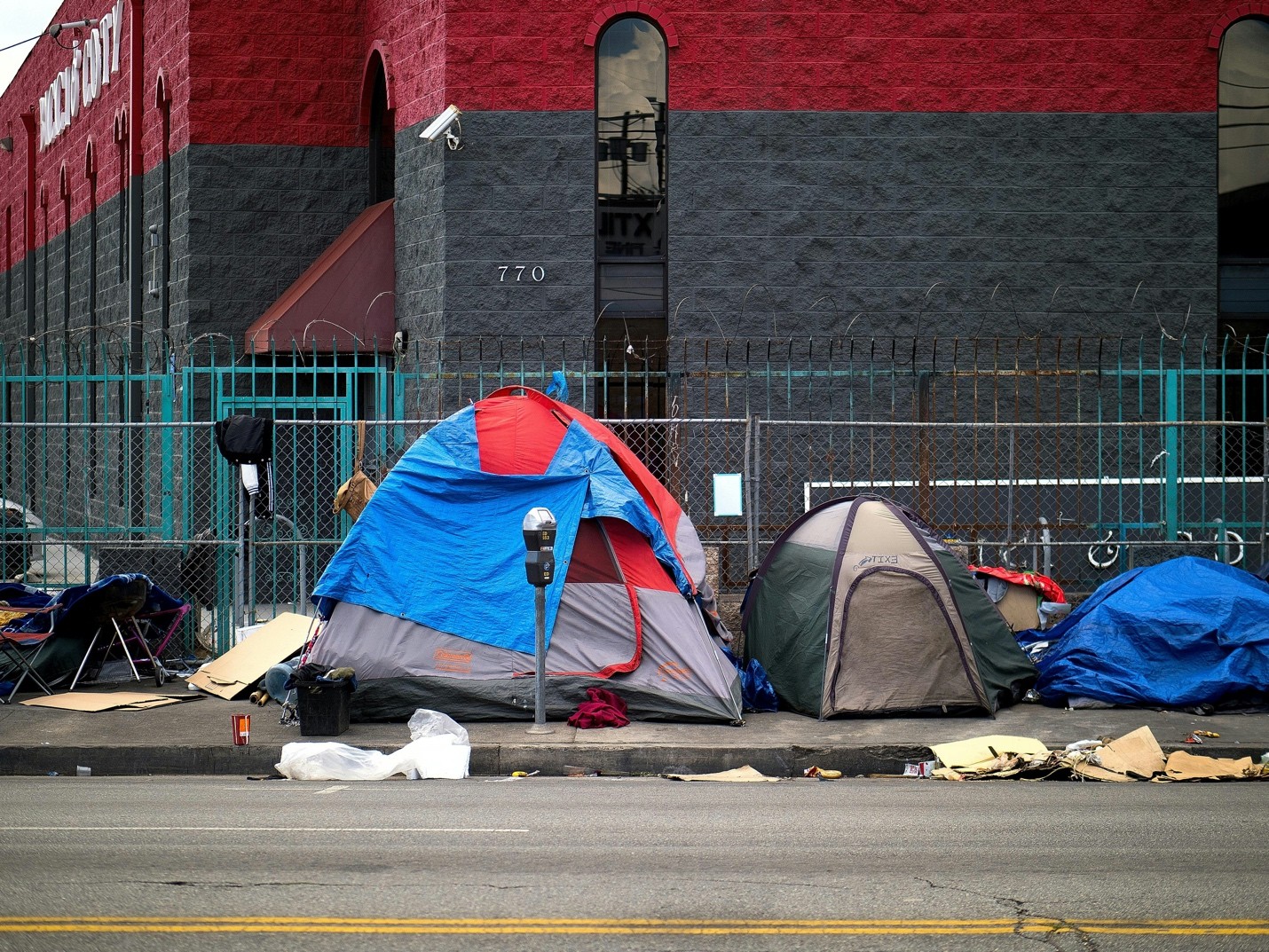
Photo courtesy of unsplash.com
Homelessness is on the rise. More than 14,000 homeless persons were reported across Pennsylvania last year[1]—an increase of over 1,400 from 2023.[2] This reflects a national 18% surge between 2023 and 2024, compared to a 12% rise the previous year.[3]
Although frequently painted with the broad brush of “homelessness,” this term masks a spectrum of experiences—from sleeping on the sidewalk, to living in tents or temporary shelters—each with distinct challenges.
Encampments, in particular, have reemerged “in numbers not seen in almost a century.”[4] Nationally, documented encampments increased by 1,342% between 2007 and 2016, and two-thirds now last more than a year, signaling a shift from temporary to semi-permanent communities.[5]
In City of Grants Pass v. Johnson (2024), the Supreme Court held that cities may enforce general bans on public camping without violating the Eighth Amendment’s Cruel and Unusual Punishments Clause, so long as penalties address conduct (camping or sleeping in public) rather than the status of being homeless.[6] The ruling overturned Martin v. City of Boise (2019), which had prohibited criminalizing outdoor sleeping when no shelter beds were available.[7] Grants Pass emphasized that this “complex” issue requires localized solutions best managed through state police power.
In response to this, Allegheny County Department of Human Services opened a winter shelter at the Community Resource Mall providing 140 beds and free transportation to Second Avenue Commons.[8] Fifty-two more beds also became available at the Salvation Army, East End Cooperative Ministry, and Second Avenue Commons.[9] At the same time, the city cleared existing encampments and placed rocks at former sites, creating “hostile architecture” to deter homeless persons’ return.[10]
Encampments have become a focal point in Pittsburgh’s homelessness debate, raising difficult questions about how these semi-organized communities should be treated under the law. To understand their role, it is important to consider why individuals choose them over shelters.
Encampments offer autonomy and control—over one’s schedule, possessions, and community—unlike shelters, which are commonly avoided by homeless due to theft, trauma, and safety concerns.[11] Short-term shelters often closed during the day, forcing residents to leave early in the morning with all their belongings, frustrating efforts to find and maintain employment.[12] Moreover, fights, abuse, and bullying are common in shelters. Former residents have described how the concentration of individuals experiencing significant personal and health issues can heighten stress and tension.[13] Conversely, encampments allow residents to choose who they live with, where they live, and the rules governing that lifestyle.[14] However, this autonomy can also enable coercion and abuse that remain largely unchecked.
Advocates sometimes describe encampments as elective communities and push for limited oversight out of respect for personal choice.[15] However, this view can overlook the inherent instability and power imbalances within these informal societies.
Katie Dorman, director of The Red Door in downtown Pittsburgh,[16] explained, “there is a hierarchy in the homeless world, and there are groups that can’t mix with other groups because someone will attack you.” Encampments often emerge from “street families”—self-arranged groups that offer protection but also reinforce cycles of control.[17] Dorman noted that “street families” are nearly always led by a woman: “There’s always a woman at the top who is the ‘street mom.’ Whether she’s a dominatrix or protector, she runs the camp.”
While these groups can provide a sense of community and identity, they can also lead to violence. “We had a young girl get stabbed from a street family issue,” Dorman recalled. “They’ll destroy your stuff, burn everything, and taint your name if there’s a falling out.”
For many women, remaining in an abusive encampment feels safer than facing the streets alone. “They know how they will be abused and by who,” Dorman says, “and sometimes, it’s better to be abused than to not be in an encampment because you are promised ‘protection.’” This “devil-you-know” dynamic only perpetuates exploitation and deserves meaningful attention in policy conversations.
By virtue of their homeless condition, encampments are built upon an unregulated and often necessarily illicit network.[18] These informal systems make safety and accountability difficult to guarantee, rendering debates over the potential benefits of encampments beside the point—communities grounded in such dynamics cannot reasonably be expected to operate outside them. Moreover, many fail to seek help for fear of retaliation from other homeless or the police.[19]
While increasing shelter capacity is certainly helpful, such initiatives remain short-term solutions to an enduring problem—not only because most shelters are temporary but because they are reactionary in nature.
Policies focused solely on managing visible homelessness—through clearances or “hostile” architecture—target a symptom as the problem, which only further disadvantages unhoused persons. Likewise, policies that romanticize encampments as self-governing communities ignore the dangers inherent in these unregulated environments. Ultimately, the solution lies in providing a more authentic version of what encampments attempt to recreate: strong family units, community, and reliable access to work and education.
[1] U.S. Department of Housing and Urban Development, HUD 2024 Continuum of Care Homeless Assistance Programs Homeless Populations and Subpopulations (2024).
[4] City of Grants Pass v. Johnson, 603 U.S. 520, 548 (2024) (quoting Lauren Dunton et al., Exploring Homelessness Among People Living in Encampments and Associated Cost,(Feb. 2020), https://www.huduser.gov/portal/sites/default/files/pdf/Exploring-Homelessness-Among-People.pdf).
[5] National Law Center on Homelessness & Poverty, TENT CITY, USA: The Growth of America’s Homeless Encampments and How Communities are Responding, (2017), https://homelesslaw.org/wp-content/uploads/2018/10/Tent_City_USA_2017.pdf.
[6] City of Grants Pass v. Johnson, 603 U.S. 520, 548 (2024).
[7] Martin v. City of Boise, 920 F.3d 584 (9th Cir. 2019).
[8] Allegheny County, DHS Announces Comprehensive Winter Shelter Plans, (Nov. 3, 2025), https://www.alleghenycounty.us/News-Articles/Allegheny-County-Press-Releases/November-2025-Press-Releases/11-3-2025-DHS-Announces-Comprehensive-Winter-Shelter-Plans.
[10] Jordana Rosenfeld, Replacing tents with boulders, Downtown boosters argue safety while advocates for homeless see exclusion, Pittsburgh’s public source (Feb. 10, 2025), https://www.publicsource.org/downtown-pittsburgh-homeless-encampments-replaced-boulders/.
[11] Ari Shapiro, Why Some Homeless Choose the Streets Over Shelters Dec. 6, NPR, (2012), https://www.npr.org/2012/12/06/166666265/why-some-homeless-choose-the-streets-over-shelters.
[12] Julie Hunter et al., Welcome Home: The Rise of Tent Cities in the United States, National Law Center on Homelessness & Poverty, (March 2014), https://homelesslaw.org/wp-content/uploads/2018/10/WelcomeHome_TentCities.pdf.
[13] 83 Nick Kerman et al. Victimization, safety, and overdose in homeless shelters: A systematic review and narrative synthesis, (2023), https://doi.org/10.1016/j.healthplace.2023.103092.
[14] National Law Center on Homelessness & Poverty, TENT CITY, USA: The Growth of America’s Homeless Encampments and How Communities are Responding, (2017), https://homelesslaw.org/wp-content/uploads/2018/10/Tent_City_USA_2017.pdf.
[15] Samir Junejo et al., No Rest for the Weary: Why Cities Should Embrace Homeless Encampments, Seattle University School of Law, (May 11, 2016), 4, https://digitalcommons.law.seattleu.edu/hrap/4.
[16] Interview with Katie Dorman, Director of The Red Door, in Pittsburgh, Pa. (Nov. 11, 2025).
[17] Lauren Dunton et al., Exploring Homelessness Among People Living in Encampments and Associated Cost: City Approaches to Encampments and What They Cost, (Feb. 2020), https://www.endhomelessness.org/wp-content/uploads/2024/10/Exploring-Homelessness-Among-People.pdf.
[18] Marcie Cipriani, Homeless encampment closed due to criminal activity, city officials said, Pittsburgh Action News, (Mar. 13, 2024), https://www.wtae.com/article/fort-pitt-boulevard-homeless-camp-closed/60192439.
[19] Martin Kaste, Homeless camps are often blamed for crime but experts say it’s not so simple, NPR, (Jan. 24, 2022), https://www.npr.org/2022/01/24/1074577305/homeless-crime-experts.